
Transit Russia
Our Transit Through Russia from Georgia to Kazakhstan
All roads lead to Kazakhstan
From Georgia, there is basically only one border crossing into Russia. You follow the Military Highway up from Tbilisi, a beautiful route through the mountains. On the online visa application, we had to indicate that we would drive via Vladikavkaz and Elista to Kurmangazy. There is a faster route to the border through Dagestan, but be aware: there are more checkpoints (yellow route).
Part of the route to Elista goes along a military road that is forbidden for tourists. If you follow Google Maps blindly, you could end up here and risk a fine. It’s important to drive around Pyatigorsk (blue route).
On the way back from Central Asia to Europe, we travel through Russia again. This time we have a 10-day transit visa instead of 3, which allows us more time to see the country. We plan to drive from Astrakhan to Elista (green route).
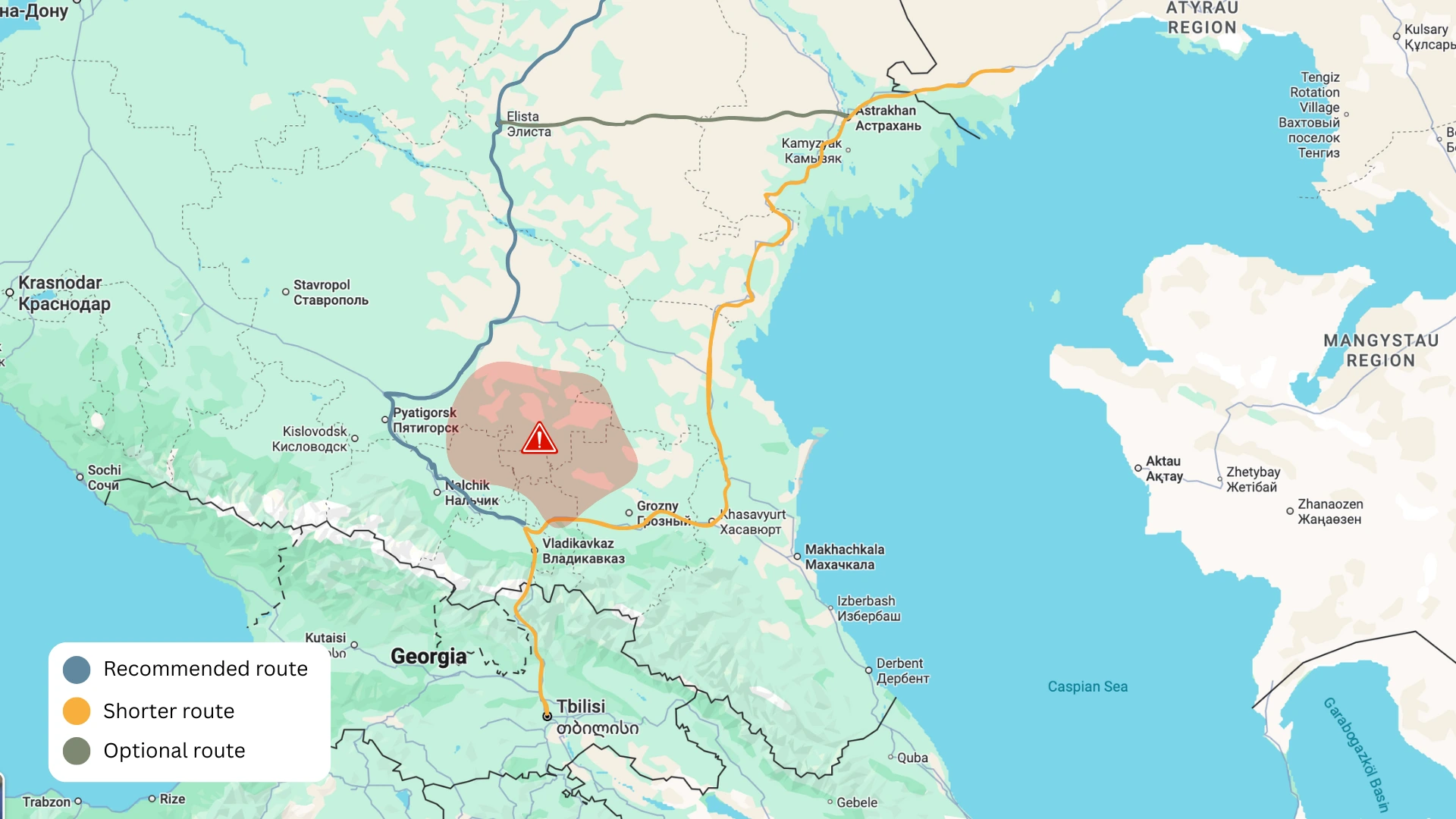
Our complete route through Russia
We drove the shorter route through Dagestan in three days (two nights), covering about 800 kilometres.
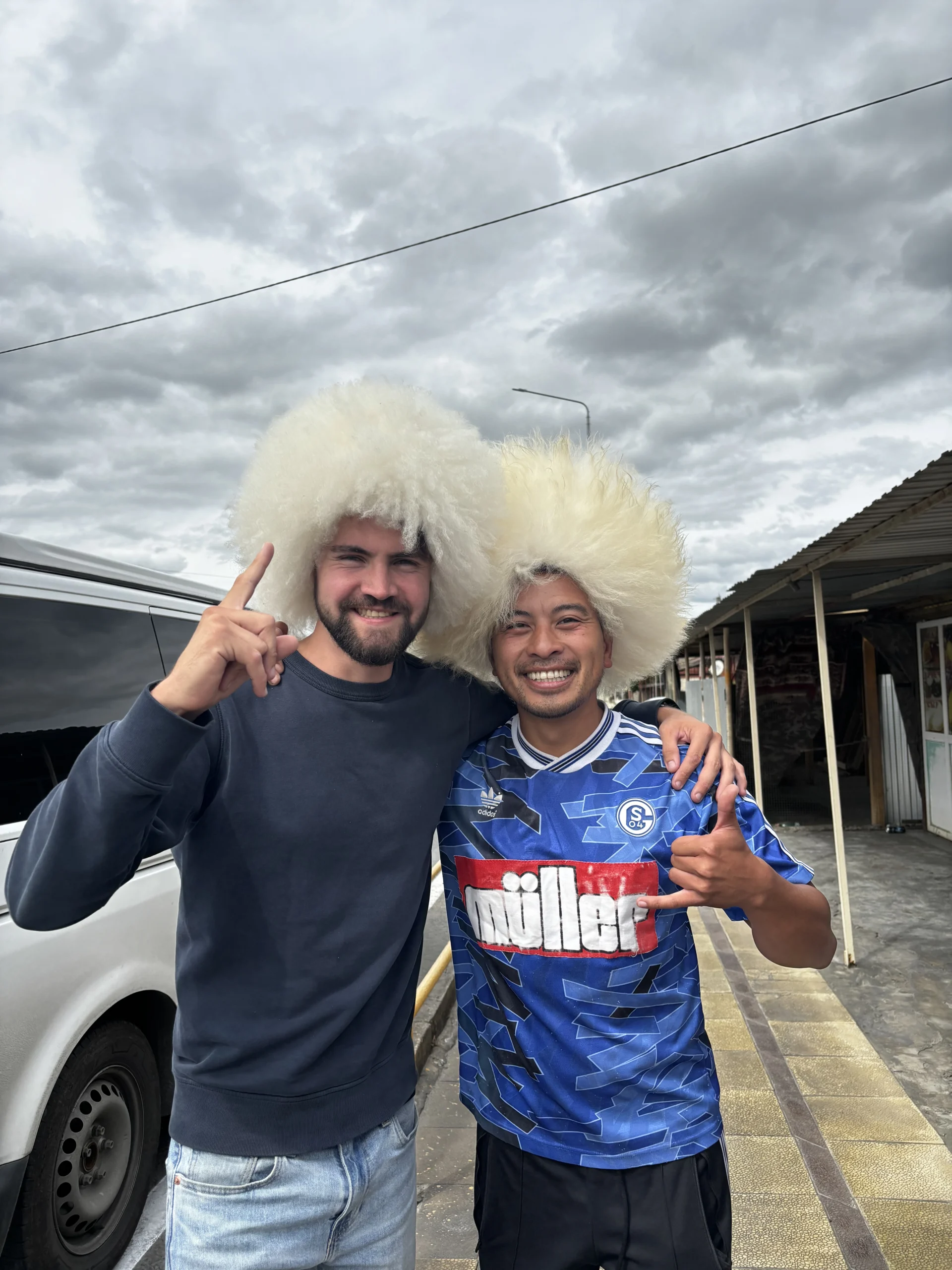
After an overnight stay at the Friendship Monument between Georgia and Russia, we set off early on 17 September towards the border crossing. In the summer months, it can be endlessly busy, especially with trucks. We arrived around 08:00, and it was quiet, but the border itself took us almost the whole day. Tessa lost sight of Sander and Kien (a German we were travelling with). Without a phone, she decided to cross the border with a local Russian as a “hitchhiker.” Sander and Kien waited for two hours before seeing via “Find My” that Tessa’s Apple Watch was already in Russia. We eventually found each other again late in the afternoon. During those five hours, Tessa was looked after by friendly truckers, who offered her food, drinks, and even a nap in the cabin.
On the way to our first overnight stop in Grozny, we were driving in the dark when we were stopped by an officer. He claimed we had missed a traffic sign and demanded a $300 fine. We managed to negotiate it down to $150. It remains difficult to deal with this kind of corruption, especially since you don’t want to cause problems in Russia.
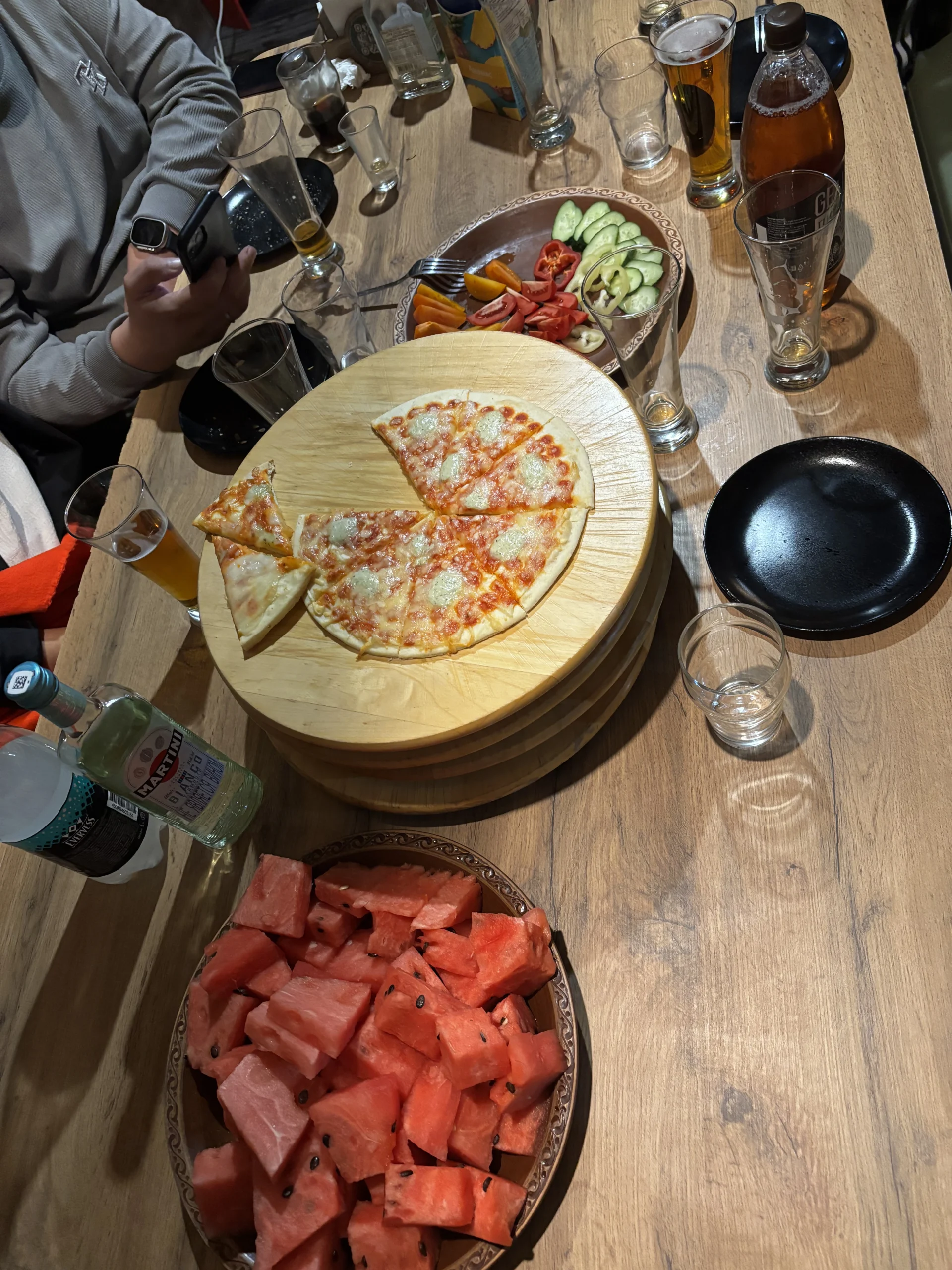
After staying overnight in Grozny (P4N #292477), we drove six hours through the steppe to Astrakhan, a city we would have liked to explore more if we had had the time. We stayed at the parking lot of Hotel Azimut in Astrakhan (P4N #166334), where we could use the toilet at the reception. Next to the hotel was Café Gellert, where the owner invited us for food and free beer. After a pleasant evening, we returned to the camper van with a bottle of homemade beer.
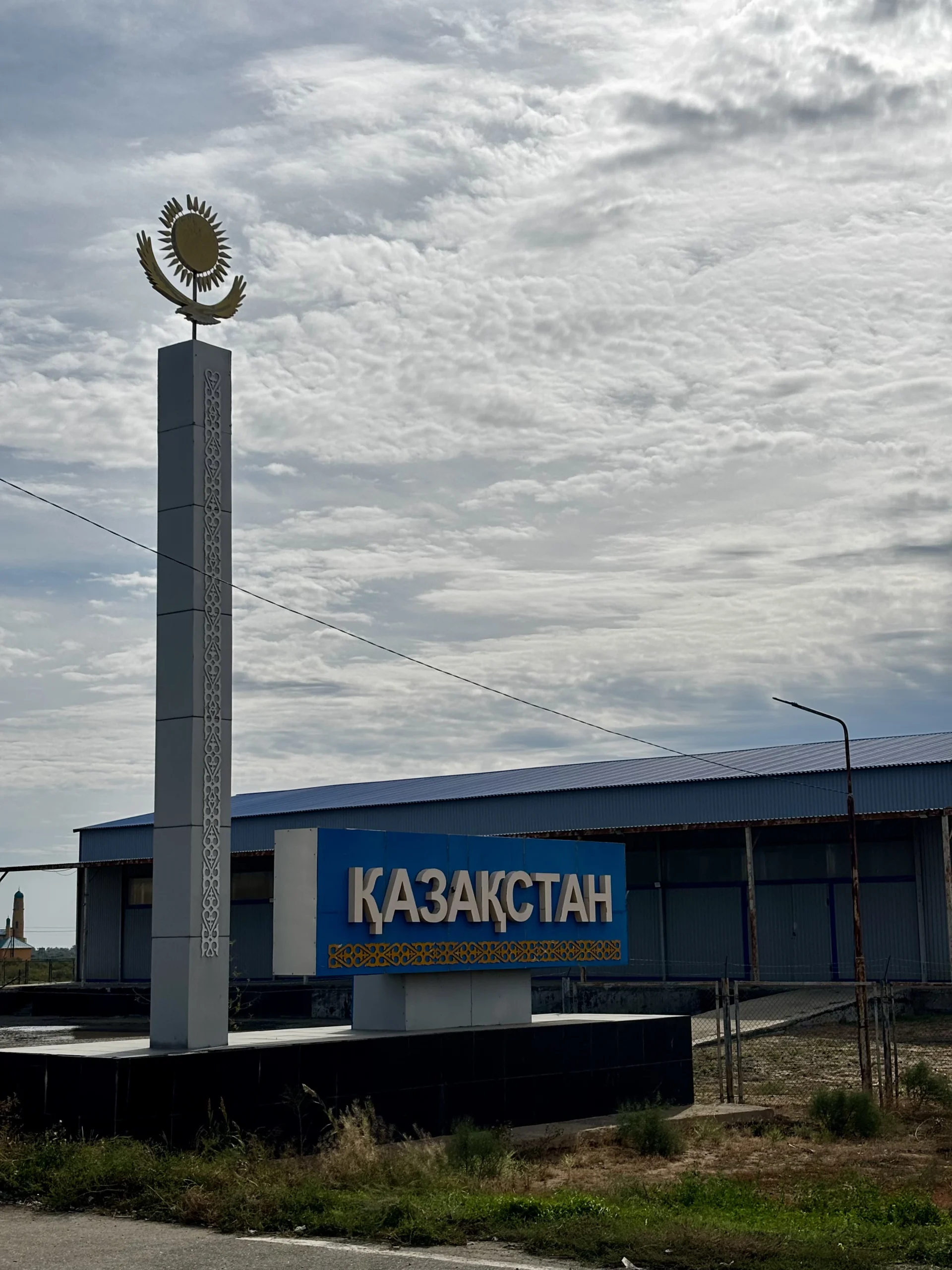
On the last day of our transit visa, we drove to the border crossing of Kotyaevka in Kazakhstan. This crossing went smoothly and took about 1.5 hours, with a small passport check and a quick inspection of the car. Just over the border, we found a hotel where we could shower and park for the night. It was a welcome stop after a few intense days, and we enjoyed a delicious traditional meal.
Crossing the border in Russia, what to expect?
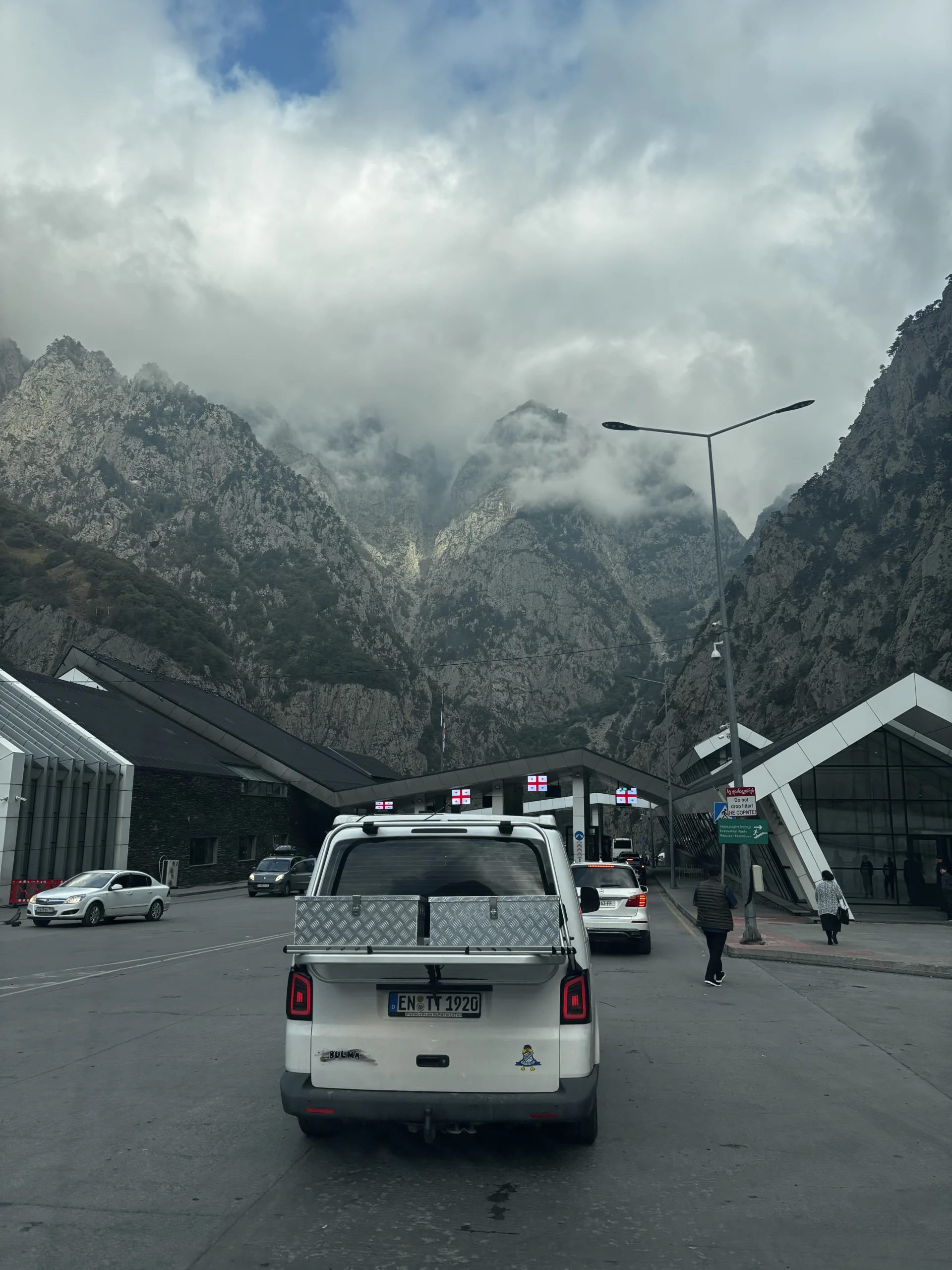
The border crossing from Georgia into Russia is quite large, partly due to the long no-man’s-land between the mountains. It starts with an initial inspection of your vehicle and passport in Georgia. Passengers must enter a building where passport control takes place, and large bags may be scanned.
After this, you can proceed with the driver and vehicle through the no-man’s-land, including a long tunnel and a lane where several vehicles are allowed through at the same time towards the Russian checkpoint with a barrier. At the Russian checkpoint, a detailed four-page form about the vehicle and the transit must be completed. Pay close attention here: one mistake means starting over. We had to fill in the form three times before everything was correct.
Although we had read about strict vehicle inspections or even x-rays, our experience was relatively smooth. This was especially a relief because we had a Starlink device with us, which is officially not allowed in Russia. We had safely hidden it in a laundry drawer between clean bedding and detergent so it wouldn’t be noticed. Caution here is very important: someone who left their Starlink on the roof was not allowed to cross.
Immediately after crossing the border, you’ll find a parking area on the right with small shops and cafés, where many truck drivers pass the time during long waits. There’s also a small office where you can arrange insurance for your car. This cost us about €30 (around 2,000 roubles) for 15 days, which is the minimum coverage available.
Practical trips for your transit Russia
There are many stories about navigation in Russia: some travellers say that Google Maps doesn’t work and that you need Yandex Maps instead. Our experience was different: Google Maps worked just fine. We do recommend downloading offline maps, as GPS can be unreliable around bigger cities like Vladikavkaz and Astrakhan. Yandex Maps can be useful as a backup, but we never needed it. For overnight stops, we used the Park4Night app.
Pay close attention to speed limits and drive slowly through towns to avoid fines. Always stop at stop signs and follow traffic rules carefully. Watch out for speed cameras and reduced speed limits, especially near pedestrian crossings (20 km/h). Overtaking should be done carefully and only where allowed.
Bringing small gifts such as local treats or souvenirs from your home country can be helpful during police or military checks. While most encounters are friendly, it’s good to stay polite and calm in any situation. As Dutch travellers, we brought stroopwafels, Dutch tea and vodka. These small and easy gifts are always appreciated. Offering something like tea, sweets, or local snacks can help create a positive atmosphere and show goodwill.
Also make sure to carry enough cash: both in rubles and, if possible, some US dollars. For our transit, we exchanged around $500 into rubles and kept another $500 as an emergency reserve. In the end, the rubles were more than enough, and we never had to touch the dollars. We also stocked up on food beforehand so we only needed to stop to sleep along the way.
Cell service and esims
There are many stories about eSIMs in Russia. Some providers reportedly don’t work, and buying a physical SIM card as a tourist can be quite difficult. Sander used an Airalo eSIM and Tessa used Yesim, but after just one day, we completely lost signal. That meant we had no way to communicate with the outside world. Luckily, after a nice evening at the Gellert Bar in Astrakhan, we were able to use their Wi-Fi. Make sure to download your entire route on Google Maps offline and be prepared to navigate completely without internet access.
Our transit through Russia to Kazakhstan: Our experience
Looking back, our transit through Russia went smoothly. Apart from the one fine, we had no issues with the authorities. The locals were incredibly friendly, curious, and welcoming towards tourists. Knowing a few words of Russian definitely helps, as English is rarely spoken. The road to Kazakhstan itself was quite monotonous: mostly long, straight stretches through the middle of nowhere. Still, it gave us a real sense of how vast Russia truly is, even though we only crossed a small part of the country.